

.png)
For manufacturers, delivering profitable products to the market has become significantly harder. Products are more complex than ever, requiring additional resources with expertise in new disciplines, driving up development costs, and putting profit margins at risk.
The Heightened Impact of External Pressures
Some of this complexity arises from external factors outside a manufacturer’s control. Customers are increasingly demanding, expecting innovative products more quickly than ever before. Competition is coming from all directions. Not only from traditional competitors, but also from new entrants. Our State of Product Development survey found that 56% of manufacturers face competition from adjacent industries, while 52% compete with low-cost or offshore manufacturers. Today’s supply chains add to the challenge. In fact, 74% of manufacturers in the survey identified supply chain disruptions or market volatility as a top challenge in product development. Beyond that, government and industry regulations are widespread, especially in High Tech and medical technology, demanding strict engineering and quality processes with thorough data collection and management.
Multi-CAD Environment Complicates Design Collaboration
Some of the complexity stems from internal issues. Remember when products were primarily mechanical? Those days are gone. Now, mechanical, electrical, and software teams all need to work together – and be productive doing it. They must ensure that form, fit, and function all work in harmony while delivering their designs on the same development and launch timeline.
However, each design discipline uses different tools, with product data stored and managed separately or, in the worst case, only on an individual engineer's drives. Managing and accessing product data across multiple design systems, let alone file folders and shared drives, negatively impacts collaboration and reduces productivity.
Chaos Hampers Productivity
Engineers Don’t Have Time to Waste
Considering the complexity of product development and the need for speed, engineers, in fact, the entire enterprise, must stay highly productive to innovate and deliver products on time. The truth is, engineers waste a lot of time. For example, in highly regulated industries like MedTech, manually assembling product documentation for a design history file is a waste of engineering time that takes away from innovation.
Too Much Time Spent on Unproductive Work
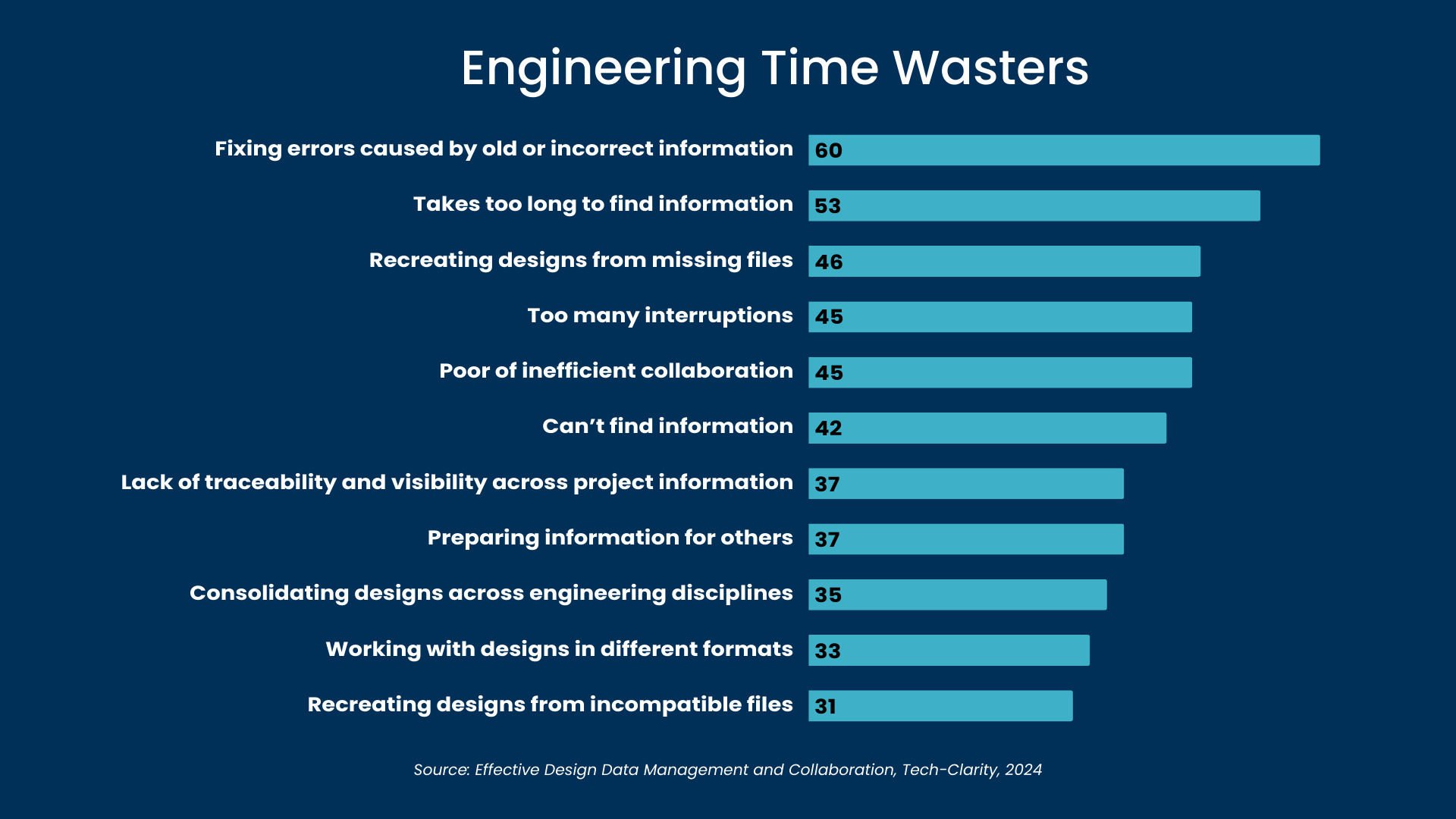
Our Effective Design Data Management and Collaboration research shows that engineers spend nearly 20% of their day on unproductive work, including fixing errors caused by old or incorrect data (60%), taking too long to find information (53%), or struggling with poor or inefficient collaboration (45%). This wasted time leads to missed deadlines, higher product costs, budget overruns, stifled innovation, and lower product quality. There is a solution: ensuring everyone has access to up-to-date, accurate product data through a product digital thread. This is an effective approach to tackle complexity, enhance collaboration, and boost productivity.
Engineers waste 20% of their day on unproductive work. That’s one day every week!
Connect Product Data
The Value of a Digital Thread
A digital thread helps manage product development complexity, accelerates the delivery of innovative products, and ensures traceability for regulatory compliance. It provides everyone access to the same, up-to-date product information, enhancing collaboration, reducing errors, and boosting productivity.
A digital thread ties product information, decisions, and history together in a structured and integrated way, capturing product innovation and knowledge throughout the product lifecycle. It establishes traceability from the early stages of innovation through development, manufacturing, service, commercialization, and field operation.
Product data from various systems, such as electrical computer-aided design (ECAD), mechanical computer-aided design (MCAD), and product data management (PDM), becomes accessible to everyone who needs it. Everyone connected to the digital thread can access accurate, current product information exactly when and where they need it. The result? Higher productivity, fewer errors, and better-informed decision making.
The digital thread tracks every action from initial concept to delivery. For those in MedTech, a highly regulated industry, or high tech, this is essential for regulatory compliance. Engineers no longer waste hours digging through emails, notes, and files trying to find the source of a change or the root cause of an issue.
Comprehensive Digital Thread
A complete digital thread extends beyond engineering. It should include data from enterprise resource planning (ERP), quality management systems (QMS), customer relationship management (CRM), and product information management (PIM) systems. When these systems communicate with each other, agility improves because new information and updates flow quickly across the organization. Our Integrating Data and Processes Across the Product Digital Thread survey shows that digital thread integration is very important to manufacturers. A full two-thirds said it’s at least important, with 21% of those citing it as critical. Want to see the most telling stat? Only a fraction of manufacturers said a digital thread isn’t important.
CAD Can Serve as the Foundation
Manufacturers Have the Design Data
Products have evolved, as has the design process. Today’s products rely on mechanical, electrical, and software to deliver innovation and performance. In fact, electronics and software have increasingly driven product innovation, often making their contributions to the product at least as important as the mechanical hardware.
Good news: some manufacturers already have a few of the key pieces, including one or more of the engineering applications that can form a product digital thread - Mechanical and Electrical CAD, PDM, and PLM.
Multiple Sources of Design Data
Most, if not all, design teams use at least one MCAD application; however, the specific application they use may vary by organizational and component provider needs and preferences, making it nearly impossible to standardize on a single MCAD tool. Sound familiar?
And then there is ECAD. With electronics integrated into nearly every product, ECAD tools are prevalent. These teams are often disconnected from other design groups, frequently in different locations. Electronic component selection is often up to the engineer's judgment, often without regard for current cost or availability.
Electrical and mechanical engineers often work in silos, only coming together at the end of the design process. That is precisely when problems are discovered, impacting quality, requiring costly rework, pushing back delivery dates, and increasing costs.
The Role of SaaS Solutions like Design Hub
Solutions like Propel Design Hub are built to help you create a digital product thread from the CAD and PDM solutions you already use. You don't have to start from scratch to speed your operations. Design Hub automates and streamlines design governance across CAD systems, syncing parts, BOMs, files, and AMLs directly into the Propel product record without leaving your current environment. See a demo of Design Hub today.
Solve your CAD-PLM problem in < 10 minutes of reading
Get the latest ebook from Tech-Clarity, explaining how your digital thread can save your engineers time while connecting product data to the rest of your enterprise, saving time and speeding revenue during NPD cycles. Get the ebook here.
.gif)
Tech-Clarity is an independent research firm dedicated to making the business value of technology clear. We analyze how companies improve innovation, product development, design, engineering, manufacturing, and service performance through the use of digital transformation, best practices, software technology, industrial automation, and IT services.


