

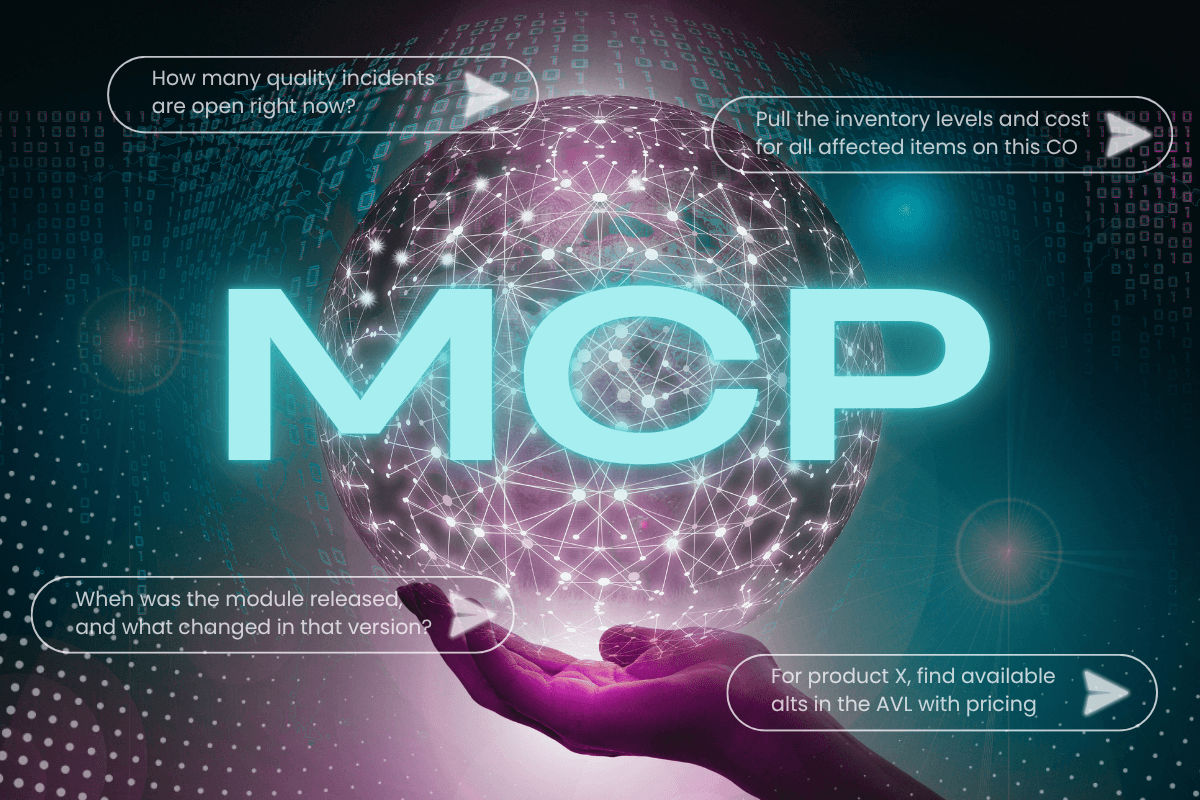
The acronym has been showing up in every AI conversation worth having: MCP, or Model Context Protocol.
If you've heard it and nodded along without fully knowing what it means, you're in good company. But make no mistake—this shift is real, it's arriving fast, and modern manufacturers who understand it early will have a meaningful advantage.
Here's what MCP is, why it matters for manufacturing, and what it looks like in practice.
The Problem It Solves
A product doesn't live in one system:
Design data sits in CAD and PLM.
Supply chain information lives in an ERP or procurement platform.
Quality records are in a QMS.
Compliance documentation is somewhere else entirely.
And that's before accounting for the spreadsheets, shared drives, and email threads that fill the gaps in between.
Getting a complete picture of a product—to make a sourcing decision, assess a change, or respond to a supply disruption—has traditionally meant stitching these systems together through complex, brittle integrations or relying on manual processes to compensate for what those integrations miss.
Either way, the result is the same: real barriers between the people who need product data and the decisions that depend on it.
A process that could take hours, or days, depending on who needs to approve what.
This is an architecture problem that’s been accepted as fact. After all, each system was built to do one job. Nobody designed them to speak to each other without a custom integration.
And anyone who's been through an enterprise IT integration project knows: those take months at best, and years at worst. When the requirements change, you start the cycle over. The result is a landscape of information silos (product data here, quality records there, procurement agreements somewhere else) that legacy systems were never designed to bridge.
MCP is a direct answer to this problem.
What is MCP?
Think: MCP is to agents what API is to developers.
Model Context Protocol is an open standard, introduced by Anthropic in November 2024, that allows AI systems and enterprise software applications to interoperate without hard-coded, point-to-point integrations
The core idea: as long as your applications support MCP connections, an AI agent can seek out information across those systems on your behalf without you specifying which system to look in.
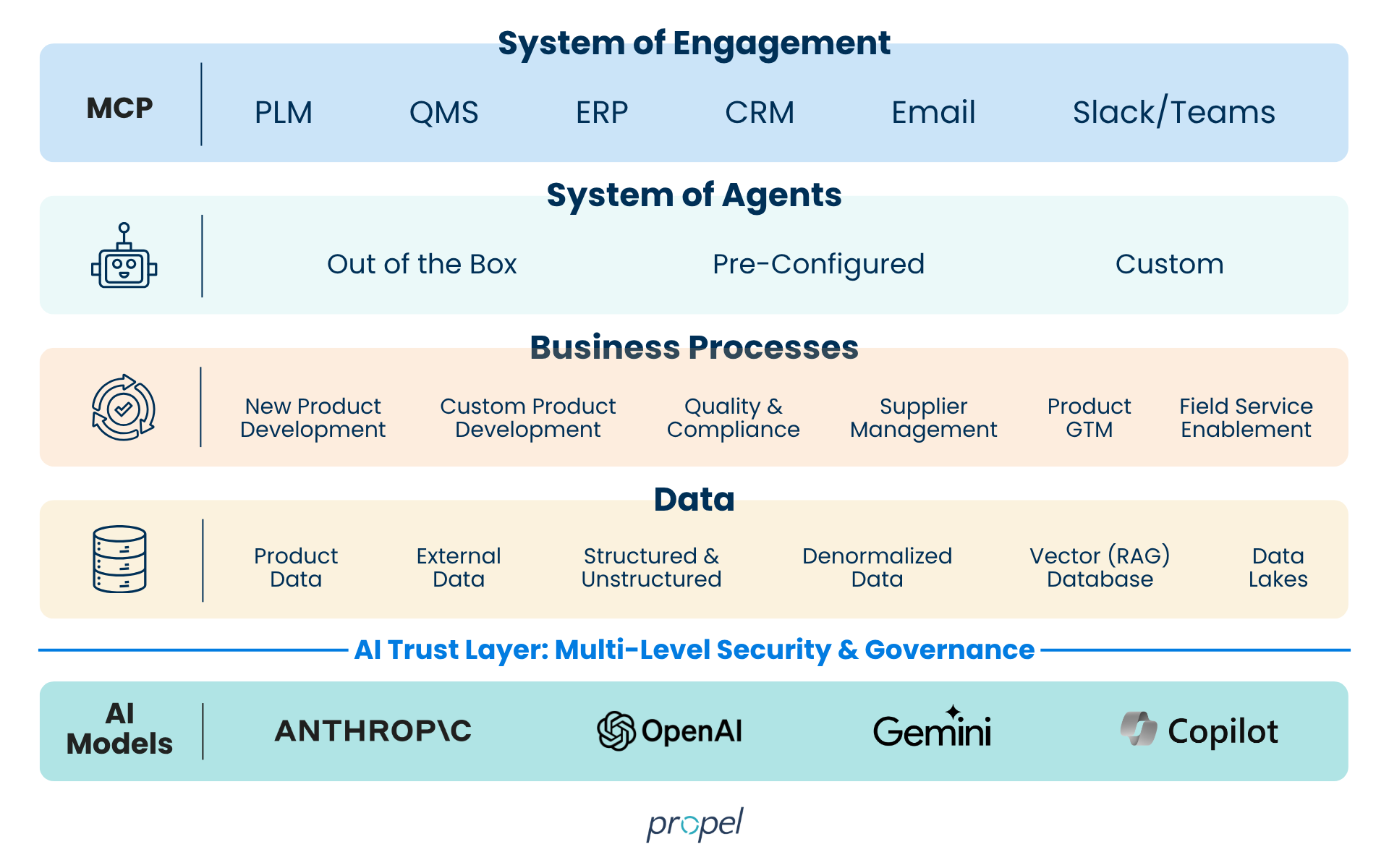
A useful analogy circulating among practitioners:
MCP is like a USB port for software integration. You don't need a proprietary cable for every device. You just need the standard port, and things connect.
The architecture has two sides:
MCP servers expose data and capabilities (i.e. your PLM, ERP, content repositories, or any other external systems you want AI to reach).
MCP clients are the AI applications that consume those capabilities, whether that's Claude, ChatGPT, Cursor, or another LLM application your team already uses.
MCP allows business users to access the power and data of enterprise applications, where in the past it required developers to use SDKs and APIs to integrate for specific use cases.
All this is to say that in practice, you can type a single natural language request, such as:
"Find me alternate parts for component [XXX], check our procurement agreements, and draft an RFQ"
…and an MCP-connected AI client will pull from data sources like your PLM, your ERP, and the web, then take action across them, without needing you to specify where any of that data lives.
Why Manufacturing AI Agents Need Context to Work
Let’s get technical for a second.
There's a reason why MCP has become essential to realizing AI's promise in enterprise settings, and it's worth understanding.
Large language models (LLMs) are, by themselves, stateless. They have no memory of your previous conversations, no access to your internal systems, and no awareness of your product data.
To get value from AI in a real manufacturing workflow, you have to give the model context: the right information, at the right time, from the right sources.
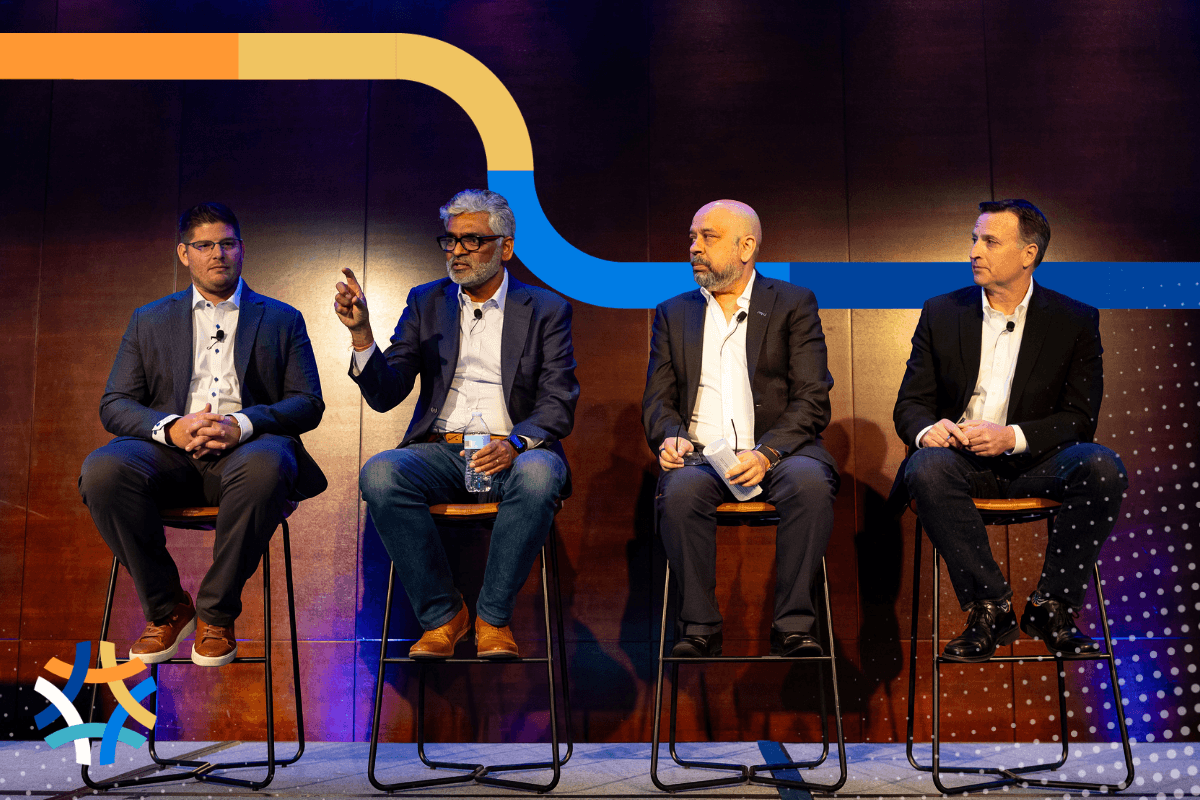
Arnab Biswas, who leads cloud consulting at Google and has worked extensively with manufacturing and life sciences companies, describes this as building an "AI harness."
The harness is what bridges the gap between a capable model like ChatGPT or Claude, and an actual business outcome rooted in your data.
MCP is one of the most important components of that harness; it's the mechanism that lets an AI application pull live, accurate context from the systems that hold your real operational data.
Without that context layer, you're asking AI to reason in a vacuum. With it, you're giving it the same information a skilled engineer or compliance manager would use to make a decision.
What It Looks Like for a Manufacturer
Consider a scenario that plays out on production floors all over the world. A back-ordered part has stopped your line. In an MCP-enabled environment, here's what a manager could do:
- Search for the back-ordered part using plain language. No system login required.
- Ask the AI to check existing approved components for a viable replacement.
- If nothing internal qualifies, prompt it to search the web for alternatives and return the top candidates with relevant specs.
- Select a replacement and create that part as a new item in your PLM, with all the details auto-populated from the discovery.
- Replace the old component in the affected assembly, with the revision automatically tracked.
- Generate a formal change order, complete with justification, affected items, and category, ready for review.
That entire flow, which would have required multiple logins, manual data entry, and back-and-forth between engineering and procurement, can run in a single conversational thread.
The AI knows where to look, acts across system boundaries, and keeps a full audit trail in the process.
[WATCH] Want to learn more about how MCP applies to your product and quality workflows? Watch Propel’s CEO explain how MCP can change the industry—including a live demo.
The Shift Happening Right Now
The speed at which MCP is gaining adoption matters. For the past couple of years, the enterprise AI conversation focused heavily on which language model to use: GPT-4 vs. Claude vs. Gemini and so on.
That conversation is shifting. As Biswas put it at Propulsion 2026, Propel Software’s user conference, "People are not talking about models. People are talking about the outcomes we are trying to get to."
MCP is the infrastructure that closes the gap between a capable model and a useful outcome. And software providers across the industry are moving fast to support it, which means the window to learn this and get ahead of it is right now.
For manufacturers, the implications span every major workflow:
- Supply chain resilience: Identifying and qualifying alternate suppliers without manually bouncing between systems.
- Change management: Pulling inventory positions, open POs, and affected item lists across ERP and PLM in a single change impact analysis.
- Quality processes: Connecting complaint data, design history files, and non-conformance records that currently sit in separate platforms, giving AI agents the breadth of context they need to be genuinely useful.
- Engineering decisions: Querying third-party component databases with the context of your own BOM data, to inform sourcing decisions directly within an agent workflow.
What You Need in Place First
MCP is powerful, but it surfaces a foundational truth about AI in manufacturing: the quality of your data determines the quality of your outcomes.
If your product data is fragmented, your compliance records are siloed, or your change history lives in email threads, an AI agent pulling from those sources will reflect that fragmentation. This problem compounds when organizations are working across a mix of modern platforms and legacy systems; MCP can bridge them technically, but it can't clean up what's in them. The protocol connects systems. The value of that connection depends entirely on what's in them.
This is why practitioners who have worked closely with AI transformation in regulated industries are consistent on one point: before you invest in agents and MCP connections, get serious about your data foundation.
The bottom line is know where your sources of truth live, make sure they're accurate, and make sure they're accessible.
Then build the harness around them.
The Takeaway
MCP isn't a buzzword for the next AI cycle. It's a structural shift in how enterprise software can work together, and it has direct, practical implications for every manufacturer trying to get more out of their existing systems landscape.
The manufacturers who will benefit most aren't necessarily the ones who adopt it first. They're the ones who understand what it requires: clean data, connected systems, and a clear view of the workflows where removing friction actually moves the business.
Start there.



.png)
.png)
