


This article was originally written for and published by Tech-Clarity.
Propulsion 2026 was in Denver this year, and I was happy to attend. My engineering degree is from the University of Colorado, so a visit to the state brought back fond memories. More importantly, I have been following Propel Software for a while and was eager to hear more about their vision and product strategy, especially regarding AI, and to engage with customers and partners to get their perspectives as well. I did not attend last year's conference; however, Jim Brown attended and provided his Propulsion 2025 Insight. From my learnings at the conference, it is clear that Propel has made tremendous progress over the past year.
Propel is in a unique position because it can leverage the robustness and technology advancements of the Salesforce platform. This means they can adopt new features quickly, which is particularly helpful in the age of AI. I was as impressed by their product delivery and roadmap as I was by their customers’ enthusiasm.
AI Vision and Strategy

Ross Meyercord, Propel CEO, opened the conference by examining the three major forces reshaping manufacturing: economic uncertainty, geopolitical disruption, and the rapid emergence of AI-driven technologies.
From an economic perspective, manufacturers continue to face pressure from rising raw material and labor costs, creating a greater need for operational agility and efficiency. Geopolitics adds further complexity, influencing sourcing strategies, manufacturing footprints, and access to critical materials.
The centerpiece of his presentation was the emergence of Model Context Protocol (MCP), an open framework designed to connect data and actions across enterprise applications. Rather than relying on predefined integrations or requiring users to navigate multiple systems, MCP enables AI agents to discover information across applications and execute tasks through natural language interactions. Among other benefits, this has significant implications for enhancing the user experience.
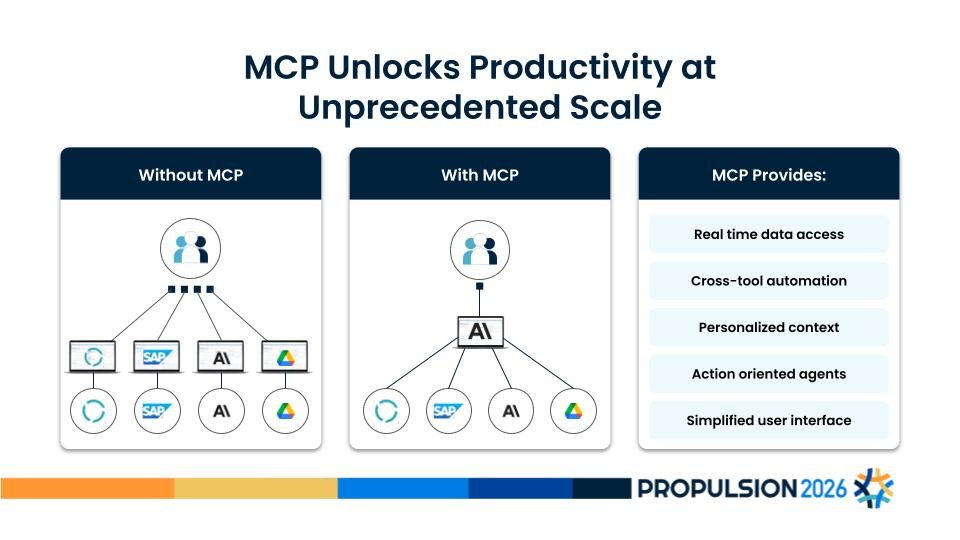
MCP Provides User Experience Options
What logically followed was the announcement of MCP support (to be released in mid-2026), positioning the platform within the emerging AI ecosystem. The vision is one in which users can access product and business information through AI assistants, regardless of the application they are working in. Using natural language prompts, users can continue to perform detailed tasks directly within Propel, such as impact analysis and quality incident management, or access Propel via an AI platform to analyze alternatives, identify suppliers, assess lead times, and even generate business documents such as RFQs. There is no need to log in to Propel or any other application.
Propel's architecture centers on business processes that connect underlying enterprise data, with an AI agent layer sitting above those processes and the user interface serving as the access point. This architecture opens Propel capabilities and data to the enterprise.
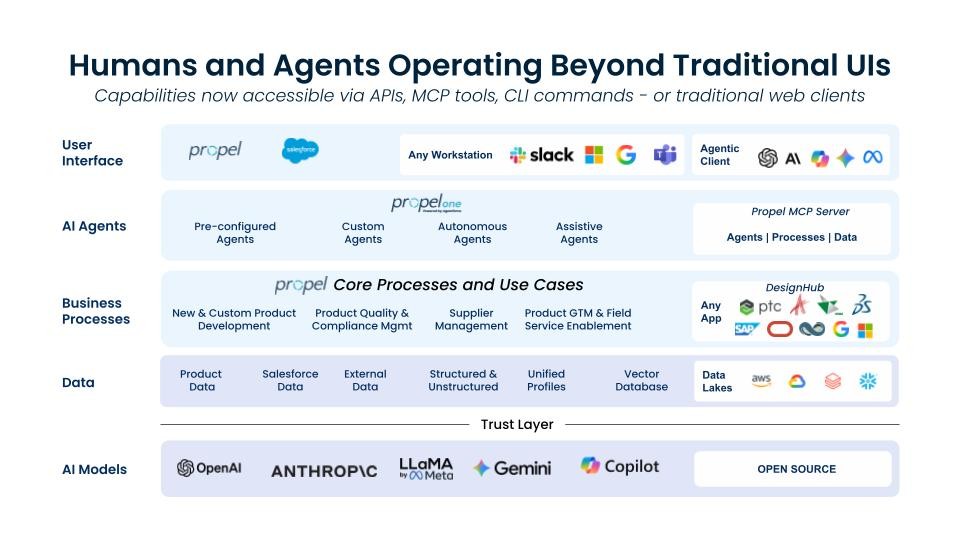
Embedded AI Expands Gains
Eric Schrader, Chief Product Officer, provided his insights on the industry's transition from AI experimentation to operational deployment. While manufacturers have embraced AI initiatives, Eric said adoption remains fragmented across organizations and workflows. This correlates well with our research, which shows that many are gaining value from AI, but only a small percentage of leaders have made significant progress scaling beyond early initiatives. Propel is embedding AI directly into product development and lifecycle processes, enabling organizations to move from isolated use cases toward enterprise-scale productivity gains.
Demonstrations showed how users can interact with product information through Propel One Assistant using natural language, reducing reliance on traditional navigation and search methods.
Looking ahead, Propel plans to expand its AI capabilities by incorporating both structured and unstructured data sources, broadening the range of potential AI-driven use cases. The product roadmap includes a Manufacturing Hub to connect Propel workflows with ERP systems, support for configurable products, and enhanced management of digital products and software-based offerings.
The company's AI strategy is anchored by Propel One, a multi-layered architecture that supports embedded, composable, and networked AI capabilities. A notable capability is the use of AI to monitor policy compliance and standard operating procedures. Demonstrations showed how organizations can automatically evaluate whether processes are being followed and generate reports to identify compliance gaps.
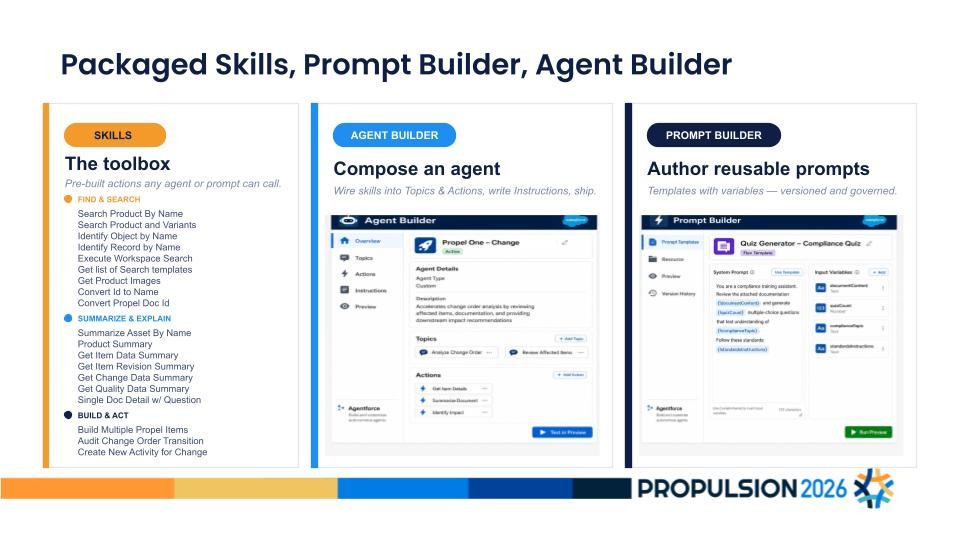
Composable AI enables customers to build and extend AI-driven workflows without extensive development effort. Using tools such as Skills, Agent Builder, and Prompt Builder, users can create custom agents and process flows with templates and guided development. These agents can be invoked from within Propel or external collaboration environments such as Slack, extending AI-assisted workflows beyond the core application.
Propel's vision includes Networked AI, which enables AI interactions across enterprise systems. Users will be able to access Propel data from external AI clients or leverage information from other enterprise applications through Propel agents. Demonstrations illustrated how users could work within external AI environments to identify components, compare specifications, evaluate alternatives, search for suppliers, and even extend searches to external sources when internal options are unavailable.
Propel also highlighted the progress of DesignHub, introduced six months ago, which is designed to improve collaboration and ensure that design data remains enriched and connected as it moves through downstream business processes. Tech-Clarity’s recently published research Building the Digital Thread to Improve NPD Performance covers the business benefits of connected data.
AI, Data, and the Digital Thread
There was an interesting discussion on the future of PLM between Ross Meyercord and Kevin Prendeville, Principal, Supply Chain & Network Operations, Deloitte. The discussion highlighted the growing complexity manufacturers face as they balance traditional business challenges with rapid technological change. A recurring theme was the continued evolution of the digital thread. What began primarily as engineering-focused Product Data Management (PDM) capabilities has expanded into a broader enterprise framework that connects engineering, manufacturing, quality, service, software, and customer-facing systems. As products increasingly incorporate software, connected services, and mobile applications, the scope and importance of product lifecycle data continue to grow.
The conversation also reflected the industry's shift in perspective on AI. Kevin stated that manufacturers are moving beyond viewing AI as an interesting technology experiment and are increasingly focused on achieving measurable business value. Realizing these benefits requires a clear understanding of business processes and a disciplined approach to identifying where automation and intelligence can create the greatest impact.
Data quality was cited as one of the most important prerequisites for AI success. They noted that AI's effectiveness is directly tied to the quality, consistency, and governance of underlying product and operational data. Organizations that have not yet established trusted, connected data foundations may struggle to achieve meaningful AI outcomes.
Kevin emphasized that technology initiatives must remain focused on business outcomes rather than technical experimentation. Questions of ownership and governance remain challenging, particularly for the digital thread, which often spans multiple functions and stakeholders. Successful transformation efforts require clear objectives, strong governance, and broad organizational alignment.
AI In Regulated Industries
Zachary Macht of KPMG explored the growing challenge of balancing AI adoption with regulatory compliance in highly regulated industries such as life sciences. Zachary emphasized that while organizations are eager to capitalize on AI's productivity and decision-support capabilities, they must do so within a framework of governance, oversight, and accountability.
A central theme was that AI cannot be treated as an autonomous decision-maker in regulated processes. Regulatory agencies, including the FDA, continue to hold organizations accountable for outcomes regardless of whether decisions were influenced by AI. As a result, companies cannot rely on explanations such as "the AI did not identify the requirement." Human review, approval, and accountability remain essential components of compliant processes.
However, Zachary also challenged the common assumption that simply placing a human "in the loop" is sufficient. Effective oversight requires knowledgeable reviewers who can critically evaluate AI-generated outputs and add meaningful judgment to the process. Human participation must function as a true control rather than a procedural checkbox.
As regulators begin evaluating AI-enabled processes, organizations should expect increased scrutiny around governance, decision-making, and traceability. Inspectors are increasingly interested in understanding how AI is used, what controls are in place, how outputs are validated, and how organizations document and manage AI-related risks.
The session concluded with a clear message: AI adoption is accelerating, and organizations cannot afford to ignore its potential.
Zoetis PLM Journey
The conference offered plenty of opportunities to hear directly from Propel customers. Gregory Yow and angela moliterno shared Zoetis' 5-year product lifecycle management journey, highlighting both the unique challenges of medical device development within a pharmaceutical organization and the value of connecting product data across the enterprise.
Zoetis, known for animal health products ranging from pet medicines to advanced vaccination technologies, described how adopting formal design control processes required a significant cultural shift. While design control is fundamental in regulated product development environments, it was not traditionally part of the pharmaceutical mindset, creating organizational challenges as the company expanded its medical device and equipment development capabilities.
The company began its PLM journey with a focus on engineering, integrating product development processes with CAD tools such as SolidWorks and subsequently extending connectivity to SAP. Over time, however, the scope expanded well beyond engineering. Zoetis described how its PLM initiative evolved into a cross-functional platform that connects engineering, manufacturing, service, and commercial to improve information flow across departments and created new opportunities to streamline customer-facing activities. This step-by-step approach, starting small and leveraging more of Propel’s capabilities over time, was a common theme across customer presentations.
Our Take
Propel is moving beyond being just a cloud-native PLM provider and positioning itself as an AI-enabled product operations platform. The announcement of MCP support is particularly significant because it shifts the conversation from using AI within PLM to accessing PLM data and processes from wherever work is being performed. This approach could help break down traditional application silos and make product information available to a much broader audience. Combined with Propel One’s embedded, composable, and network AI capabilities, Propel appears focused on delivering practical business value rather than AI as a standalone feature. We are excited to see what comes next.


.png)


